Choosing reliable Truck Brake Shoes suppliers requires more than comparing prices on a spreadsheet. Fleet operators need consistent friction performance, accurate dimensions, strong backing plates, and dependable delivery across borders. A poorly matched shoe can create uneven braking, drum scoring, noise, or unexpected downtime. Those problems become expensive when a loaded truck is far from the workshop.
Commercial vehicle braking engineer Dr. Richard M. Bishop observes, “Brake performance begins with correct friction material, not the lowest purchase price.” This principle guides our selection of the 10 Best Truck Brake Shoes Suppliers for Global Buyers. The companies considered here are assessed through practical purchasing criteria, including product coverage, manufacturing control, certification transparency, testing capability, packaging quality, and after-sales support. Small details matter. Check the lining thickness. Inspect the rivets. Confirm the application code.
No supplier fits every fleet.
Some manufacturers serve high-volume distributors, while others support specialized truck models or regional replacement markets. Buyers should still verify current certificates, cross-reference part numbers, and request technical data before placing large orders. Supplier websites can be incomplete. Product photos may not show critical differences.
This guide is therefore a starting point, not a substitute for engineering review. It highlights credible options and practical questions for importers, wholesalers, repair networks, and fleet managers. The final decision should reflect vehicle specifications, operating conditions, local compliance requirements, and available technical support. Reliability is built through evidence, careful inspection, and honest comparison.
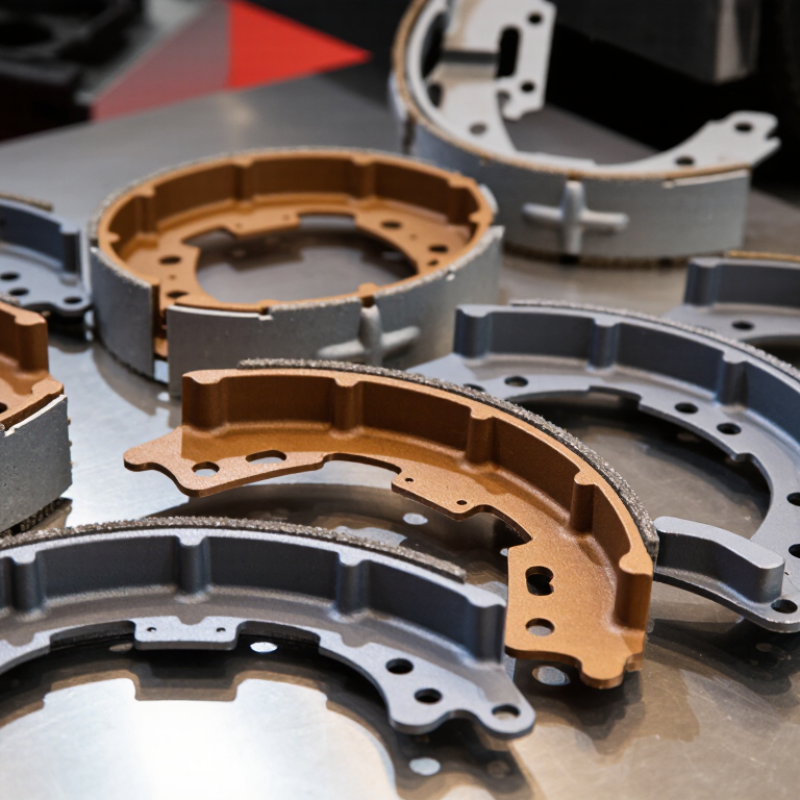
Truck brake shoes are curved friction components inside drum brakes. When the driver presses the brake pedal, hydraulic pressure pushes the shoes against the drum’s inner surface. Friction slows the wheel and helps control the truck’s heavy load. Simple, but not insignificant.
Their condition affects stopping distance, heat management, and braking consistency. Worn linings may reduce friction, while cracked shoes or uneven wear can point to broader problems, such as poor adjustment or a damaged drum. A squeal or vibration is useful evidence, but it is not a diagnosis. Inspect the complete brake assembly and follow the vehicle maker’s service specifications.
Tips: Check lining thickness, cracks, loose rivets, and uneven contact during scheduled inspections. Replace shoes in axle sets when required, and verify drum condition before fitting new parts. Keep service records; patterns across inspections can reveal recurring wear. Measurements matter more than appearance alone. One overlooked detail: a new shoe cannot correct a brake system that is out of adjustment.
| No. | Supplier Evaluation Area | What Truck Brake Shoes Are and Why It Matters | What Global Buyers Should Verify |
|---|---|---|---|
| 1 | Vehicle and axle coverage | A brake shoe carries the friction lining in a drum-brake assembly. When the brake is applied, the shoes press against the drum to create friction and slow the wheel. | Request an application list covering the relevant truck, trailer, axle, and brake dimensions. Confirm fitment against the vehicle or axle manufacturer’s specifications. |
| 2 | Dimensional accuracy | Shoe geometry and mounting features must match the brake assembly; an incorrect fit can prevent proper installation or operation. | Check engineering drawings, critical dimensions, tolerances, and inspection records for the exact part number. |
| 3 | Friction-material specification | The lining’s friction behavior influences braking performance, heat generation, wear, and noise. Performance depends on the complete brake system and operating conditions. | Request the lining specification and relevant test data. Confirm that the material is appropriate for the intended vehicle, duty cycle, and market requirements. |
| 4 | Regulatory compliance | Brake-component regulations and approval requirements vary by jurisdiction and product category. Vehicle-level braking rules do not automatically establish approval for every replacement component. | Identify the destination-market rules and ask for applicable certificates, approval markings, and supporting documentation. Verify their scope and validity independently. |
| 5 | Manufacturing quality control | Consistent production helps keep dimensions and material properties within the supplier’s stated specifications from batch to batch. | Review the quality-management system, incoming-material controls, in-process checks, final inspection, and corrective-action procedures. |
| 6 | Testing and traceability | Testing and traceability help buyers investigate product issues and link supplied parts to production batches. | Ask which tests are performed, how results are recorded, and whether each shipment can be traced by part number, batch, or production date. |
| 7 | Material and chemical declarations | Brake friction materials can contain multiple constituents, and chemical restrictions differ among markets. Buyers need accurate product-specific declarations. | Request current material and restricted-substance documentation, and check applicable local rules rather than relying on a general statement. |
| 8 | Packaging and shipment protection | Brake shoes can be damaged or corroded during handling and transport if packaging is unsuitable for the route and storage conditions. | Confirm protective packaging, corrosion-control measures where appropriate, carton identification, and export-packaging requirements. |
| 9 | Supply capacity and lead time | Reliable replenishment supports fleet maintenance and parts availability, especially when buyers manage multiple vehicle applications. | Request written production capacity, standard and sample lead times, minimum order quantities, and a process for communicating delays. |
| 10 | Warranty and technical support | Clear after-sales procedures help buyers address fitment questions, product complaints, and potential quality issues. | Review warranty terms, claim evidence requirements, response times, technical-document availability, and the supplier’s process for investigating complaints. |
| Buyer note: This table provides a practical supplier-screening framework, not a ranked list of named suppliers. Confirm product fitment, test evidence, and legal requirements for each vehicle application and destination market. | |||
Truck brake shoes are curved friction parts inside drum brakes. Hydraulic pressure pushes them against the drum’s inner surface. Friction slows the wheel.
Their condition affects stopping distance, heat control, and braking consistency. Worn linings may reduce friction. Heavy loads make small defects more serious.
Listen for squealing and feel for vibration. Check for thin linings, cracks, loose rivets, and uneven contact. These signs offer clues, not a diagnosis.
No. A new shoe cannot correct poor adjustment or a damaged drum. Inspect the complete assembly before installation. Measurements matter more than appearance.
Request batch material records, dimensional results, and certificates linked to the shipment. Ask about bonding, friction consistency, heat resistance, and wear testing.
Ask every supplier the same technical questions. Compare test methods, limits, delivery history, packaging, and complaint handling. A low quote may hide extra costs.
Confirm lead time, carton size, pallet strength, moisture protection, and shipping marks. For sea freight, record the loading port and document responsibilities. Small errors can change freight charges sharply.
It should state coverage time, mileage limits, evidence requirements, and exclusions. Confirm the process for photos, sample returns, technical review, and replacements.
Ask one difficult technical question before ordering. Judge the answer, not just the response speed. Named contacts and clear response targets help. Communication can still slow during holidays.
No. Pre-shipment inspection adds useful evidence, but it cannot replace supplier controls. Verify samples independently before a large order. No checklist is perfect.
Truck Brake Shoes are essential friction components in heavy-duty braking systems, helping commercial vehicles slow down safely under demanding loads and road conditions. This guide explains their function, construction, and importance while outlining how global buyers can assess suppliers through manufacturing experience, material consistency, testing procedures, certifications, production capacity, and quality-control systems. It also presents ten leading supplier categories for international sourcing without focusing on specific brand names.
The comparison covers product range, compatibility with different truck models, customization options, packaging, and technical support. Buyers will also find practical guidance on requesting samples, confirming specifications, reviewing lead times, arranging international shipping, and evaluating warranty and after-sales services. By considering performance reliability, compliance with applicable standards, communication efficiency, and total purchasing cost, fleet operators and distributors can make more informed decisions when selecting Truck Brake Shoes for safe, consistent, and long-term vehicle operation.

 WEST INDUSTRY