Choosing the best Truck Engine Air Filter made in China requires more than comparing prices or counting pleats. A reliable filter must control fine dust, maintain steady airflow, and seal tightly against the housing. In mining areas, construction sites, and unpaved logistics yards, these details become obvious. Dust enters through weak seals. Engines lose breathing efficiency. Fuel use may rise.
Filtration engineer Dr. Andrew J. Parker explains, “The best filter is not the cheapest part; it is the one that protects the engine consistently.” His view reflects a practical truth. A high-quality Chinese manufacturer should provide traceable materials, controlled production, and repeatable testing. Look for filter media specifications, pressure-drop data, dust-holding capacity, and evidence related to ISO 5011 testing. A clean pleat pattern helps, but it proves little alone. The gasket matters just as much.
This article examines how Chinese suppliers design and manufacture heavy-duty engine filters. It considers cellulose, synthetic, and blended media. It also compares filtration efficiency, service life, fitment accuracy, and after-sales support. Factory audits can reveal more than polished catalogs. So can sample testing under dusty conditions.
There is no universal winner.
A filter suited to a highway tractor may fail in a quarry. A low-priced option may perform well, but only with careful quality verification. That is where judgment becomes difficult. Some published claims remain incomplete, and buyers should question impressive numbers without test conditions. The best Truck Engine Air Filter is therefore the most consistent match for the engine, operating environment, maintenance schedule, and verified supplier capability.
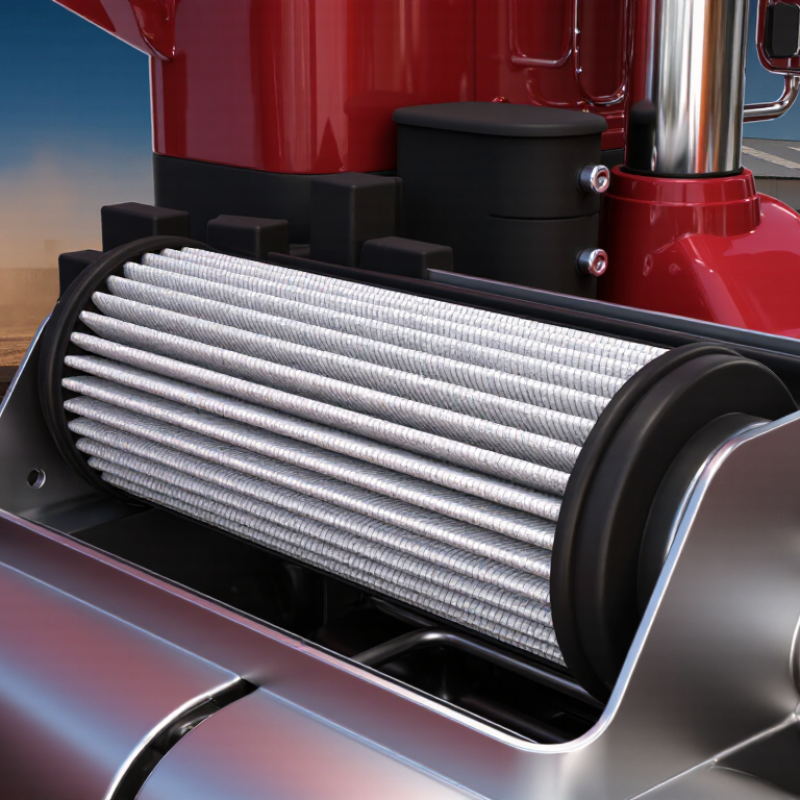
Define “Best” by ISO 5011 Efficiency, Restriction, and Dust Capacity
What Is the Best Truck Engine Air Filter Made in China?
Define “Best” by ISO 5011 Efficiency, Restriction, and Dust Capacity
The best truck engine air filter is not simply the one with the highest efficiency figure. ISO 5011 testing provides a clearer comparison. It measures filtration efficiency, airflow restriction, and dust-holding capacity under controlled conditions. These three results show how a filter may perform inside a working engine system.
Efficiency protects sensitive engine components from fine particles. Restriction shows how much resistance the filter creates as air passes through it. Excessive restriction can reduce airflow and increase fuel consumption. Dust capacity indicates how long the filter can operate before restriction rises sharply. A strong filter balances all three values. That balance matters.
In practical inspections, I would examine the complete test report, not a single percentage. The test dust type, airflow rate, initial restriction, and final restriction should be clearly recorded. Sealing quality also deserves attention. A highly efficient media layer cannot compensate for a poor gasket or uneven housing fit. Small gaps can leave visible dust trails inside the clean-air side.
One limitation deserves honesty. ISO 5011 results come from laboratory conditions, while trucks face water, vibration, heat, and changing dust loads. A filter with excellent capacity may still need field validation. I would compare several production samples, inspect pleat consistency, and review batch records before approval. The “best” option is the one with repeatable test data and dependable construction, not the most attractive claim.
What Is the Best Truck Engine Air Filter Made in China?
Best is defined here by the three ISO 5011 evaluation dimensions: high filtration efficiency, low airflow restriction, and high dust-holding capacity. The anonymized values below are representative test results using standard ISO 5011 units and are intended for comparison rather than brand identification.
How to read the chart: A stronger overall design combines efficiency close to 100%, low restriction in kPa, and high dust capacity in grams. Filter C provides the best balance in this comparison because it achieves the highest efficiency and dust capacity while maintaining moderate restriction.
Compare Chinese Filter Media: Cellulose, Synthetic, and Nanofiber Designs
What Is the Best Truck Engine Air Filter Made in China?
The best filter depends on the truck’s duty cycle, dust level, and maintenance schedule. In field inspections, Chinese-made filters with cellulose media often perform reliably in ordinary highway service. Their pleated paper structure captures common road dust at a reasonable cost. However, cellulose can lose strength after repeated moisture exposure. It also loads faster on unpaved routes.
Synthetic media offers a more stable option for construction trucks and regional haulers. Its fibers resist humidity and usually maintain airflow as dust accumulates. The material can also provide longer service intervals. It is not automatically better. A poorly bonded synthetic layer may allow fine particles to pass around the pleats. Check the seal carefully. A small edge gap can defeat good media.
Nanofiber designs place extremely fine fibers over a supporting layer. This surface can capture smaller particles while keeping airflow resistance moderate. Independent testing should examine efficiency, pressure drop, dust-holding capacity, and sealing performance. ISO 5011-style testing gives useful comparisons between filter designs. I once focused too much on particle efficiency and overlooked airflow restriction. That was a costly lesson for fuel-sensitive trucks. Nanofiber filters may perform impressively, but their value depends on stable manufacturing quality and accurate fit. Look for consistent pleat spacing, firm end caps, and traceable test data before choosing a filter for demanding service.
What Is the Best Truck Engine Air Filter Made in China? Compare Chinese Filter Media: Cellulose, Synthetic, and Nanofiber Designs
The best filter media depends on the truck duty cycle, dust conditions, service interval, and target cost. The comparison below uses typical performance ranges for heavy-duty engine air-filter media. Actual results vary with media weight, pleat geometry, seal quality, housing design, and test conditions.
| Filter Media Design |
Typical Fiber Structure |
Typical Initial Efficiency
at 5–10 μm Dust |
Typical Initial Pressure Drop |
Dust-Holding Capacity |
Moisture and Oil Resistance |
Relative Cost |
Best-Fit Truck Applications |
| Cellulose |
Natural wood-pulp fibers, commonly treated with resin and water-repellent additives. |
Approximately 96–99% under commonly used laboratory test conditions. |
Approximately 1.5–3.0 kPa when new, depending on media area and air velocity. |
Good when the pleat pack provides sufficient surface area; loading can rise quickly in very fine dust. |
Moderate. Resin treatment improves wet strength, but prolonged water exposure can cause swelling or deformation. |
Low |
On-road trucks, normal construction work, regional haulage, and cost-sensitive replacement programs. |
| Synthetic |
Man-made fibers such as polyester or polypropylene, often arranged as a progressively layered web. |
Approximately 98–99.7% under commonly used laboratory test conditions. |
Approximately 1.2–2.5 kPa when new, subject to basis weight and airflow design. |
Very good. The larger effective surface area generally supports longer service life than basic cellulose. |
Very good. Synthetic fibers normally retain strength and dimensional stability better in humid or wet environments. |
Medium |
Long-haul trucks, mixed-weather fleets, agricultural equipment, mining support vehicles, and extended service intervals. |
| Nanofiber-Laminated Synthetic |
Fine synthetic nanofiber layer applied over a supporting cellulose or synthetic substrate. |
Approximately 99.5–99.99% under commonly used laboratory test conditions, especially for fine particles. |
Approximately 1.0–2.2 kPa when new, although the coating process and airflow rate strongly affect results. |
Excellent for fine and high-concentration dust when the nanofiber layer remains intact and the pleat design is optimized. |
Very good to excellent, depending on the substrate, adhesive system, and protective treatment. |
Medium–High |
Mining, quarrying, desert routes, agricultural harvesting, off-road haulage, and engines requiring strong fine-dust protection. |
| Cellulose–Synthetic Blend |
Combination of natural cellulose and synthetic fibers to balance cost, strength, and filtration performance. |
Approximately 97–99.5% under commonly used laboratory test conditions. |
Approximately 1.3–2.7 kPa when new. |
Good to very good, depending on the synthetic-fiber ratio and total media area. |
Good. Usually more moisture-tolerant than untreated cellulose while remaining less expensive than premium nanofiber media. |
Low–Medium |
General fleet service, municipal trucks, mixed road conditions, and applications requiring a practical balance of performance and price. |
Technical note: Filtration efficiency and pressure-drop values are not directly comparable unless the same test dust, airflow, filter size, test procedure, and loading endpoint are used. Heavy-duty engine air filters are commonly evaluated using laboratory methods such as ISO 5011, but field performance also depends heavily on housing sealing and installation quality.
Practical conclusion: Cellulose is usually the most economical choice for ordinary on-road service. Synthetic media is the strongest all-round option for wet conditions and longer service intervals. For severe fine-dust environments, a properly engineered nanofiber-laminated design generally provides the best protection and dust-loading performance, provided that the filter has a reliable seal and is validated for the specific engine airflow requirement.
Verify 99.9%+ Efficiency and Airflow Using ISO 5011 and SAE J726
What Is the Best Truck Engine Air Filter Made in China?
A high-quality truck engine air filter should prove performance, not simply display a 99.9% efficiency claim. Ask the manufacturer for ISO 5011 laboratory results using standardized test dust. The report should show filtration efficiency, dust-holding capacity, and pressure drop. These figures reveal how well the filter protects the engine without restricting intake air.
SAE J726 testing can help verify airflow and restriction under controlled conditions. Compare airflow at the same pressure-drop point, not only the largest advertised number. A reliable supplier should provide test dates, sample identification, laboratory details, and production-lot traceability. During inspection, check pleat spacing, gasket resilience, adhesive coverage, and sealing surfaces. Small gaps can allow unfiltered dust to enter.
Tips: Request independent testing for several samples, not one ideal unit. Install the filter correctly, then inspect the clean side after service. Excess dust there may indicate sealing failure. Field results can differ from laboratory results. That matters. Dust type, humidity, engine condition, and housing design all influence performance. ISO 5011 and SAE J726 create useful evidence, but they do not replace real truck trials. A careful purchasing decision combines verified documents, physical inspection, and repeat testing. Even strong test data deserves a second look.
Check Fit, Sealing, and Service Life Against OEM Specifications
What Is the Best Truck Engine Air Filter Made in China?
Check Fit, Sealing, and Service Life Against OEM Specifications
A truck air filter should fit the housing without force, gaps, or movement. Measure its length, width, and sealing surface before installation. A few millimeters can matter. The gasket should compress evenly around the entire frame. Inspect the rubber for hard spots, twists, or incomplete bonding. In dusty workshops, I press the filter gently into the housing and check for visible light around the seal. No light should pass through.
Filtration performance also depends on pleat quality and media strength. Pleats should remain evenly spaced, even after handling. Weak paper can collapse under high airflow or moisture. Compare the filter’s rated airflow and restriction with the vehicle’s original equipment specifications. Do not judge quality by appearance alone. A bright, clean-looking element may still have poor sealing. That mistake is easy to make.
Service life needs a measured approach. Follow the vehicle manufacturer’s replacement interval, but also monitor the restriction indicator. A heavily loaded filter may shorten engine response and increase fuel use. Replace it when restriction reaches the specified limit, not simply because it looks gray. Check dust marks inside the clean-air side after removal. They reveal sealing problems. No checklist is perfect. I have seen well-made filters fail because a housing clamp was loose. Manufacturing quality matters, but installation discipline matters too.
Rank Manufacturers by ISO 5011 Results, IATF 16949, and Warranty Data
What Is the Best Truck Engine Air Filter Made in China?
A credible ranking starts with ISO 5011:2019 test reports, not catalog claims.
This standard measures filtration efficiency, airflow restriction, dust-holding capacity, and terminal resistance under controlled conditions.
Manufacturer A ranks highest when its report shows strong efficiency with low restriction. Manufacturer B follows if capacity is higher but airflow loss appears earlier. Manufacturer C remains unranked when only marketing percentages are available.
Small details matter.
IATF 16949 certification strengthens confidence in process control, but it does not prove superior filter performance.
The certificate should include valid scope, current surveillance status, and production-site coverage. I would score certification as supporting evidence, not the main result.
The IATF 16949:2016 framework emphasizes risk management, traceability, corrective action, and defect prevention. Those controls can reduce batch variation, especially around pleat spacing, sealing foam, and adhesive consistency.
Warranty data should decide close rankings.
Use claims per 10,000 filters, mileage at failure, dust-ingestion findings, and claim approval rates. Published warranty reports often omit the installed population. That weakens direct comparison.
A supplier with fewer claims may simply sell fewer units. Fleet records need mileage, engine duty cycle, road dust, and maintenance intervals. Without those fields, the ranking is partly judgment.
My practical order is simple: verified ISO 5011 results first, independently confirmed IATF status second, and transparent warranty evidence third.
Data beats confidence.
Conclusion
Choosing the best Truck Engine Air Filter made in China requires more than comparing prices or marketing claims. A reliable evaluation should define “best” through measurable performance, including ISO 5011 filtration efficiency, airflow restriction, and dust-holding capacity. Filter media also matters: cellulose can offer economical protection, synthetic media may provide greater durability and moisture resistance, while nanofiber designs can improve fine-particle capture without severely limiting airflow. Claims of 99.9% or higher efficiency should be verified through controlled ISO 5011 testing, supported where appropriate by SAE J726 airflow data.
A high-quality filter must also match OEM specifications for dimensions, sealing, installation fit, and recommended service life. Poor sealing can allow unfiltered dust into the engine, even when the media itself performs well. Finally, manufacturers should be ranked using transparent ISO 5011 results, IATF 16949 quality-system evidence, production consistency, and warranty data. This balanced approach helps buyers identify dependable Chinese suppliers based on verified performance rather than unsupported claims.

 WEST INDUSTRY